Flying Termites or Flying Ants? How to Tell the Difference
Spring in southeastern New Mexico brings warm days, blooming desert scrub, and swarms of winged insects appearing near windows and doorways. Knowing which insect you're looking at may be the difference between a minor ant problem and thousands of dollars in structural repairs.
What You Need to Know
- Termites and flying ants swarm around the same time of year, but they require completely different treatments — and different levels of urgency.
- Three quick visual checks — antennae shape, waist shape, and wing size — can help you identify which insect you're seeing.
- Termite swarmers found inside your home almost always mean an active colony is already established somewhere in the structure.
Flying Termites or Flying Ants? How to Tell the Difference in New Mexico
Every spring, Bob Reed Pest Control Inc. takes calls from homeowners who found a pile of winged insects near a window or crawling out of a baseboard. The first question is always the same: are these termites or ants?
It is a reasonable question. Both insects swarm in spring, both have four wings, and at a glance they look similar enough to cause real confusion. Getting the identification right matters because the urgency — and the treatment — are completely different for each one.
Why Do Termites and Ants Swarm at the Same Time?
Swarming is the reproductive phase for both insects. When a colony matures, it produces winged males and females — called alates — that emerge to mate and start new colonies. Both termites and ants are triggered by the same environmental cues: warm temperatures, rising humidity, and often a rain event just before the swarm.
In New Mexico, subterranean termites typically swarm from late February through May. Drywood termites, which are also present in the drier parts of southeastern New Mexico, tend to swarm in fall. If you're seeing winged insects right now, in spring, subterranean termites are the more likely concern.
A swarm itself is brief — usually a matter of minutes to an hour. If you miss it, what you'll find afterward is a pile of discarded wings. Both termites and ants shed their wings after mating, so a cluster of wings on a windowsill is often the first clue a homeowner notices.
The Three Checks: How to Tell Termites from Flying Ants
In our 44 years serving southeastern New Mexico, we've seen homeowners dismiss a termite swarm as ants more times than we can count. The three physical differences below can be checked even without magnification if the insects are still present.
1. Antennae Shape
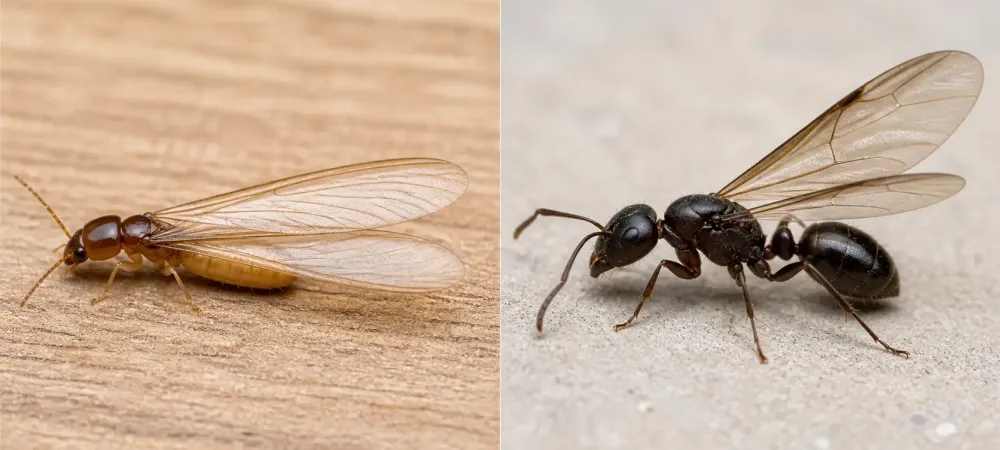
Termites have straight, bead-like antennae — they point directly forward without any visible bend. Flying ants have elbowed antennae that bend at a noticeable angle, similar to a bent elbow. This is often the easiest feature to spot.
2. Waist Shape
Termites have a broad, rectangular body with no visible pinch between the thorax and abdomen — the body is roughly the same width from head to tail. Flying ants have a narrow, pinched waist. The segmented "hourglass" shape of an ant's body is obvious even on a small insect.
3. Wing Size
Termites have four wings of equal length — all four extend well past the body and are the same size. Flying ants have two pairs of wings of unequal size: the front wings are noticeably larger than the hind wings. If you find discarded wings, termite wings will all look identical; ant wings will be mismatched.
Quick Answer: What Is the Easiest Way to Tell Termites from Flying Ants?
Check the waist and the wings. Termites have a straight, rectangular body with no pinched waist, and all four wings are the same length. Flying ants have a narrow, pinched waist and unequal wings. If you find a pile of identical wings near a window, that is a strong indicator of termites.
What Does It Mean If You Find Them Inside Your Home?
Location matters a great deal here. Finding winged insects outside in spring, near soil or landscape beds, is relatively common and does not necessarily indicate a problem inside your structure. Finding swarmers — or piles of their wings — inside your home is a more serious signal.
What we've found, time and again, is that swarmers emerging from inside walls, baseboards, or near a crawl space opening almost always means an established colony is already present. Termite swarmers are not scouts looking for a place to start — they are reproductives leaving a mature colony that may have been feeding inside your structure for years without any visible sign.
The swarmers themselves cause no structural damage. Worker termites cause the damage. But seeing swarmers is the colony announcing its presence. That is the moment to act.
What About Carpenter Ants?
Carpenter ants deserve a specific mention because they are the ant species most commonly confused with termites. They are larger than most ants, dark brown or black, and they do live inside wood — which makes the confusion understandable.
The critical difference: carpenter ants do not eat wood. They excavate it to build galleries for nesting. The damage they cause can look similar to termite damage on the surface, but the interior of carpenter ant tunnels is smooth and clean, while termite damage leaves a muddy, layered appearance. Carpenter ants also still have the pinched waist and elbowed antennae that distinguish all ants from termites.
If you have carpenter ants, that is a pest problem worth addressing through residential pest management. If you have termites, that is a separate and more urgent situation that requires a dedicated inspection and treatment plan.
Signs of a Termite Problem Beyond the Swarm
If you missed the swarm or are unsure what you saw, look for these other indicators of termite activity:
- Mud tubes — pencil-width tunnels of dried mud running along your foundation, walls, or crawl space supports. Subterranean termites build these to travel between soil and wood while staying protected from open air.
- Hollow-sounding wood — tap on baseboards, door frames, or exposed beams. Wood that sounds hollow when tapped may have been fed on from the inside.
- Blistering or darkening paint — moisture from termite activity can cause paint to bubble or darken, particularly around window frames and baseboards.
- Frass or pellets — drywood termites leave behind small, dry pellets (called frass) near the wood they are infesting. These can look like fine sawdust or small seeds gathering near baseboards or windowsills.
- Discarded wings in piles — found near windows, light sources, or entry points after a swarm event.
What to Do If You Think You Have Termites
If you find swarmers inside your home, do not seal the opening they are coming from. Blocking the exit will cause them to find alternate routes — sometimes deeper into the structure. Instead, contain a few specimens in a sealed bag if you can, note where they appeared, and contact a pest control professional as soon as possible.
A professional termite inspection will locate any active colonies, assess the extent of any damage, and outline treatment options. In New Mexico, treatment typically involves liquid soil treatments, bait systems like Sentricon, or a combination of both depending on the species and the severity of the infestation.
Waiting to see if the problem resolves on its own is not a realistic option. Termite colonies do not move on. They continue feeding until the food source is gone or a treatment stops them.
Reducing Termite Risk Around Your Home
No home is completely immune to termites, but there are steps that reduce the conditions termites look for:
- Keep wood — firewood, lumber scraps, or landscape timbers — away from the exterior of your home and off direct soil contact.
- Fix leaking pipes, faucets, or roof drainage that creates moisture against your foundation.
- Keep gutters clear so water drains away from the structure rather than pooling at the base.
- Maintain a gap between soil and any wood elements of your home's exterior, including siding and door frames.
- Schedule regular professional inspections — especially if your home has a crawl space or was built on a slab in an area with known termite pressure.
What we tell homeowners in Chaves, Eddy, Lea, and the surrounding counties is this: given the termite pressure in southeastern New Mexico, an annual inspection is a reasonable part of home maintenance, not a reaction to a crisis. Catching activity early gives you options. Catching it after the damage is visible narrows them considerably.
Not Sure What You're Looking At? We Can Help.
Bob Reed Pest Control Inc. has been inspecting and treating homes across southeastern New Mexico for 44 years. If you found winged insects in or around your home and want a definitive answer, contact us for a free termite consultation and estimate. We will inspect the property, identify what you're dealing with, and give you a clear picture of what — if anything — needs to be done.
There is no cost to find out. There can be a significant cost to waiting.